Hebrews 11 says that Noah, by his obedient actions, condemned the world around him. Is it true that I can, simply by doing my best to be faithful and live a sanctified life, be a damning presence in the lives of those who are choosing a sinful lifestyle?
The answer is “yes,” in every decision I make that is between two opposite or radically different propositions. By approving one proposition I naturally imply that the opposite decision is not the one I prefer. In cases of morality and spirituality, I often imply, by my life choices, that the lifestyle of another, is damnable. This is particularly true if I ever attempt to verbally convince another person to forsake the spiritual path that he/she is on and to live as I have chosen to live. And yet, if I enjoy the prospect of heaven, then by the very nature of Christianity, I can and will tell others about the salvation for which I am so thankful. And inherent in the word “saved” is the concept of something awful (hell) from which I have been rescued—saved. I imply, that without change and submission, my neighbor is condemned. (That’s what makes evangelism so unpleasant in our minds, which have been conditioned by tolerance.)
Because of my choice, I do “condemn” the world.
Being told that one is doing life wrong, is not generally accepted well in our haughty, and pluralistic society. Being asked to change is threatening to personal autonomy. We live in a world in which the concept of becoming slaves to righteousness (Romans 6:16) is just not even palatable. And yet, that’s clearly the choice I must make according to the Word of God.
And there we land. Does the Word of God—the Bible—have authority over my life? It will tell each of us that we’ve made choices that are damnable. It convicts and I choose to humble myself to its power or to walk in my own pride and selfishness.
But when I choose my own way, let me tell you, I will be necessarily be condemned in that world of selfishness/self-righteousness, by those who have bowed their knees to Jesus.
Noah did not choose to condemn. He chose to obey. And in that righteousness—in those righteous deeds—he condemned the world.
When people say, “Don’t judge me!”, they often, in fact mean, “Don’t condemn me by your very walk with Christ.”
By faith Noah, being divinely warned of things not yet seen, moved with godly fear, prepared an ark for the saving of his household, by which he condemned the world and became heir of the righteousness which is according to faith. Hebrews 11:7
 Jesus said this of first century Chorazin:
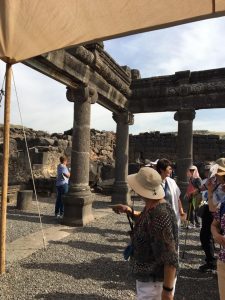 One has to reflect on the truth that the ruin of the architecture has little significance when compared to the eternal ruin and destruction of thousands of souls living in Chorazin during and after the earthly life of the Master Miracle-worker; souls who were so close to the physical evidence of God among them, but turned a blind eye to what was obviously supernatural.
 This seat of Moses was elaborately carved of stone and, from it, the law was regularly read by those who were living symbols without substance; proclaiming one thing and doing another. In fact, by the time of the worship of the era we were viewing, the rejection of the Messiah had been persisting in this place for three centuries. The Jews who sat in Moses seat in this place could have read the gospel of Matthew, where the warning about their hypocrisy was given by Christ himself. But they were uninterested in the Messiah, having rejected the powerful testimony—even the resurrection—of the One who gave the stern warning to the residents of the specified town of Chorazin.
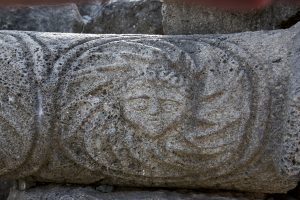 destroyed when the Jews returned to periods of stricter observance of the law; and I observed the underground bath house. Looking at the ruins of the houses in the center of the city, I could see that they were in rows and that families lived in close proximity to one another. I imagined Jewish children running across the narrow lanes and traveling with their parents to the synagogue on the Sabbath. I pondered the tragedy that finally overtook these children when their synagogue and civilization was finally destroyed, likely by an earthquake, in the fourth century. I grieve, even as I write, to understand that many of them died along with their parents on that awful day. I saw the “ghosts” of the innocents clinging to their parents as the earth enveloped them. I heard the screams and the crashing of stones. But to think that